
Understanding Screen Mesh: The Foundation of Every Great Screen Print

Not all screen meshes are the same. From bold graphics to intricate designs, the right mesh can significantly impact ink transfer, print quality, and production efficiency. Explore the fundamentals of mesh selection and why it forms the foundation of every successful screen print.
JSIPL Team
ChatGPT Image Aug 3, 2026, 10 26 28 AM

Understanding Screen Mesh: The Foundation of Every Great Screen Print

Introduction

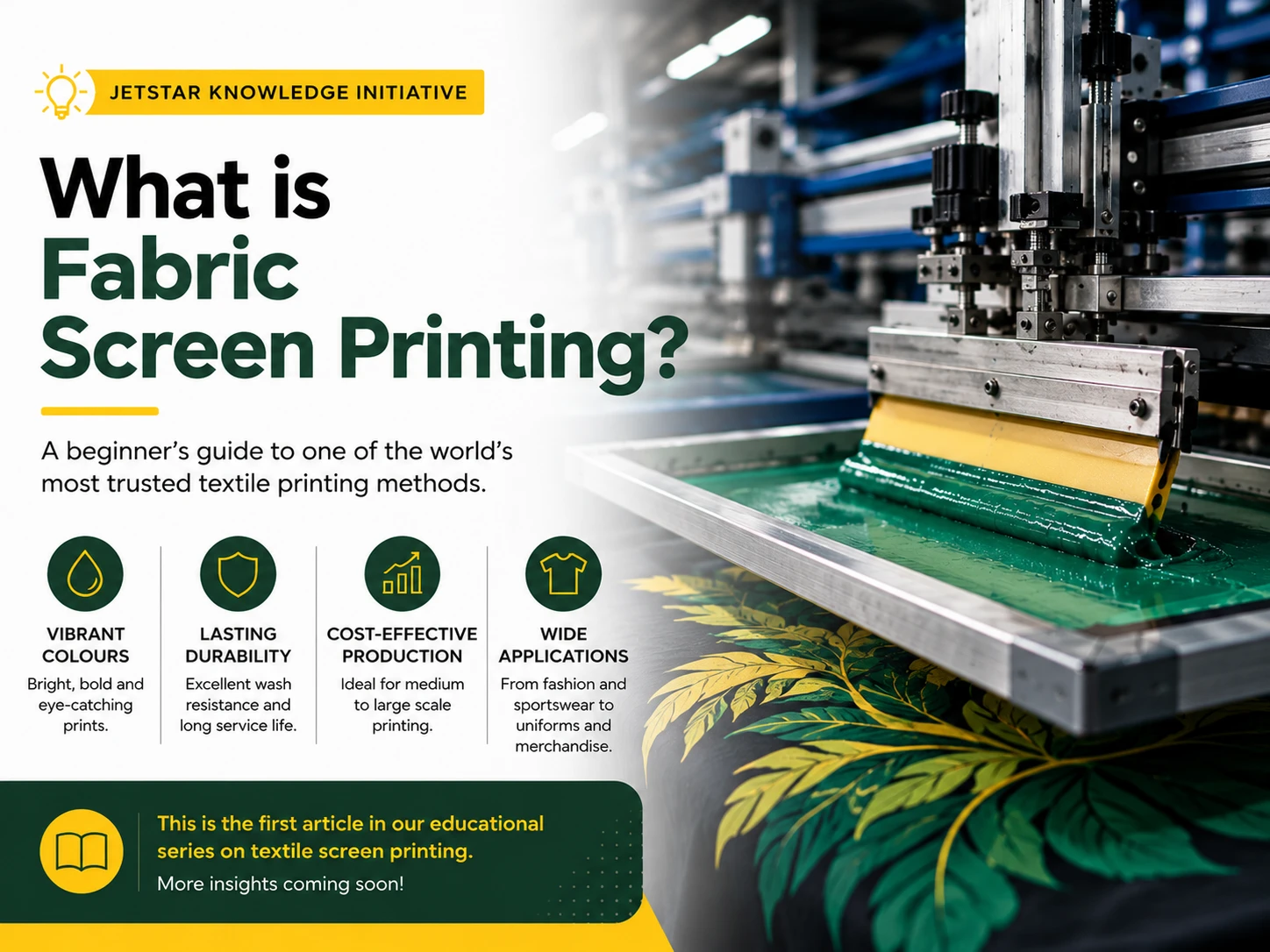
In our previous article, we explored the fundamentals of fabric screen printing and understood how a design is transferred onto fabric through a specially prepared screen.

At first glance, every screen may look almost identical—a frame with a stretched mesh ready for printing. However, experienced printers know that one of the most important decisions in the entire printing process is made long before the first drop of printing ink (colour) ever touches the fabric.

That decision is selecting the right screen mesh.

The mesh may appear to be a simple woven fabric, but it quietly controls some of the most important aspects of printing—how much ink reaches the fabric, how sharp the design appears, and how consistently the final print is reproduced.

Understanding the screen mesh is one of the first steps towards mastering the art and science of fabric screen printing.


What Exactly is a Screen Mesh?

Every screen printing frame is fitted with a finely woven fabric known as the screen mesh.

This mesh acts as the bridge between the artwork and the fabric. During screen preparation, certain areas of the mesh are blocked using a stencil, while the remaining open areas allow printing ink (colour) to pass through and form the required design.

Although the mesh itself is lightweight and almost transparent, its role in the printing process is anything but simple.

The material from which it is woven, the size of its openings, its tension, and the way it is prepared all influence the quality of the final print.

Simply put, the screen mesh is not just a supporting material—it is a precision tool.


Understanding Mesh Count

If you were to place two screens side by side, they might appear almost identical.

However, a closer look would reveal that the number of openings in each mesh can be very different.

This characteristic is known as mesh count.

Mesh count refers to the number of mesh openings (or threads, depending on the standard being followed) within one linear inch of the screen.

Although this may sound like a small technical detail, it has a significant influence on the final print.

In simple terms:

  • Lower Mesh Count → Larger Openings → Higher Ink (Colour) Deposit

  • Higher Mesh Count → Smaller Openings → Lower Ink (Colour) Deposit

This relationship forms the foundation of screen mesh selection.


Why Does Mesh Count Matter?

One of the most common misconceptions among beginners is that selecting the highest mesh count automatically produces the best print.

In reality, there is no "best" mesh.

The right mesh is simply the one that best suits the artwork, the fabric, the printing ink (colour), and the desired printing result.

For example, a bold logo on a dark sweatshirt requires a completely different ink deposit than a finely detailed illustration on a light cotton T-shirt.

The screen mesh controls that balance.

Selecting the correct mesh helps achieve:

  • Sharp image reproduction

  • Consistent colour coverage

  • Controlled ink deposit

  • Better production efficiency

  • Reduced printing defects

  • Improved overall print quality

In other words, the mesh doesn't decide what to print—it decides how the print will be created.


How Mesh Selection Influences Printing

Rather than thinking of mesh count as simply "high" or "low," it is better to understand what each category is designed to achieve.

Low Mesh

Low mesh screens have relatively larger openings.

These allow a greater amount of printing ink (colour) to pass through the screen, making them ideal for applications where heavy ink coverage is required.

Typical applications include:

  • Bold graphics

  • Puff printing

  • Metallic inks

  • Glitter inks

  • High-density effects

  • Dark-coloured fabrics

Advantages

  • Greater ink deposit

  • Excellent opacity

  • Strong colour coverage

Considerations

Because more ink passes through the screen, extremely fine details may not reproduce as clearly.


Medium Mesh

Medium mesh screens provide a balance between ink deposit and image detail.

For this reason, they are among the most commonly used meshes in textile printing.

They are suitable for:

  • General garment printing

  • Logos

  • Standard production work

  • Everyday textile applications

Advantages

  • Balanced ink transfer

  • Good print definition

  • Versatile across many applications


High Mesh

High mesh screens contain much smaller openings.

These allow a more controlled amount of printing ink (colour) to pass through, making them suitable for highly detailed artwork.

Typical applications include:

  • Fine text

  • Halftones

  • Intricate illustrations

  • Process colour printing

Advantages

  • Superior detail reproduction

  • Cleaner edges

  • Better image definition

Considerations

Because less ink is transferred, they are generally not suitable for applications requiring heavy ink deposits.


Choosing the Right Mesh: A Quick Guide

Selecting the right mesh isn't about choosing the finest or the coarsest option—it's about matching the mesh to the printing job.

As a general guideline:

  • Lower mesh counts allow more printing ink (colour) to pass through the screen. They are commonly used for bold graphics, specialty inks, and applications where a heavier ink deposit is required.

  • Medium mesh counts provide a balance between ink deposit and image detail, making them suitable for a wide range of everyday textile printing applications.

  • Higher mesh counts produce finer image details by allowing a thinner layer of ink to pass through the screen. They are often preferred for intricate artwork, halftones, and detailed multi-colour designs.


Did You Know?

Many printing issues that appear during production are often blamed on the machine or the printing ink.

In reality, the root cause can sometimes be traced back to the screen mesh selected before printing even began.

Choosing the appropriate mesh at the preparation stage can prevent many quality issues before they occur.


Common Mistakes to Avoid

Even experienced printers can encounter problems when mesh selection is overlooked.

Some common mistakes include:

  • Using the same mesh for every printing job.

  • Selecting mesh without considering the artwork.

  • Ignoring screen tension during preparation.

  • Using specialty inks with unsuitable mesh.

  • Failing to clean the mesh thoroughly after production.

Small oversights during screen preparation often lead to larger problems during printing.


Jetstar Practical Tip

When selecting a screen mesh, don't begin by asking:

"Which mesh should I use?"

Instead, ask yourself:

  • What fabric am I printing?

  • How much printing ink (colour) does this design require?

  • Is the artwork bold or highly detailed?

  • What finish am I trying to achieve?

Answering these questions first will naturally guide you towards the most suitable mesh for the job.


Best Practices

For consistently high-quality prints:

  • Match the mesh to the artwork.

  • Consider the printing ink (colour) system being used.

  • Maintain proper screen tension.

  • Inspect the mesh regularly for damage.

  • Clean the screen thoroughly after every production run.

  • Replace worn or damaged meshes before they affect production quality.

Consistency begins long before printing starts.


Conclusion

The screen mesh may not be the most visible part of the printing process, but it is certainly one of the most influential.

Every successful print begins with a series of well-informed decisions, and mesh selection is one of the earliest—and most important—among them.

When the right mesh is paired with the right artwork, the right printing ink (colour), and the right production process, it creates the foundation for prints that are sharp, consistent, durable, and visually impressive.

Because in screen printing, quality is rarely created by chance—it is created through the decisions made before production even begins.

What Comes Next?

The screen controls how much printing ink (colour) reaches the fabric—but what exactly is that printing ink, and why are there so many different types?

From soft-feel fashion prints to high-performance sportswear and specialty effects, different applications demand different ink systems.

In the next edition of the Jetstar Knowledge Initiative, we'll explore the world of screen-printing inks and understand how choosing the right ink influences durability, appearance, comfort, and long-term performance.


Ready to upgrade your screen printing workflow?

Talk to our team about CTS systems, installation, and nationwide support tailored to your mill.